breastfeeding, parenting, newborn It's More Than Milk breastfeeding, parenting, newborn It's More Than Milk

Is My Baby Getting Enough?

Things no one told me about before I became a parent: I will spend a lot of time analyzing and discussing my baby’s poop! One of the biggest concerns I hear from my prenatal clients is knowing if their baby has gotten enough. Here’s an easy way to tell if your baby is getting enough in the first week of life.

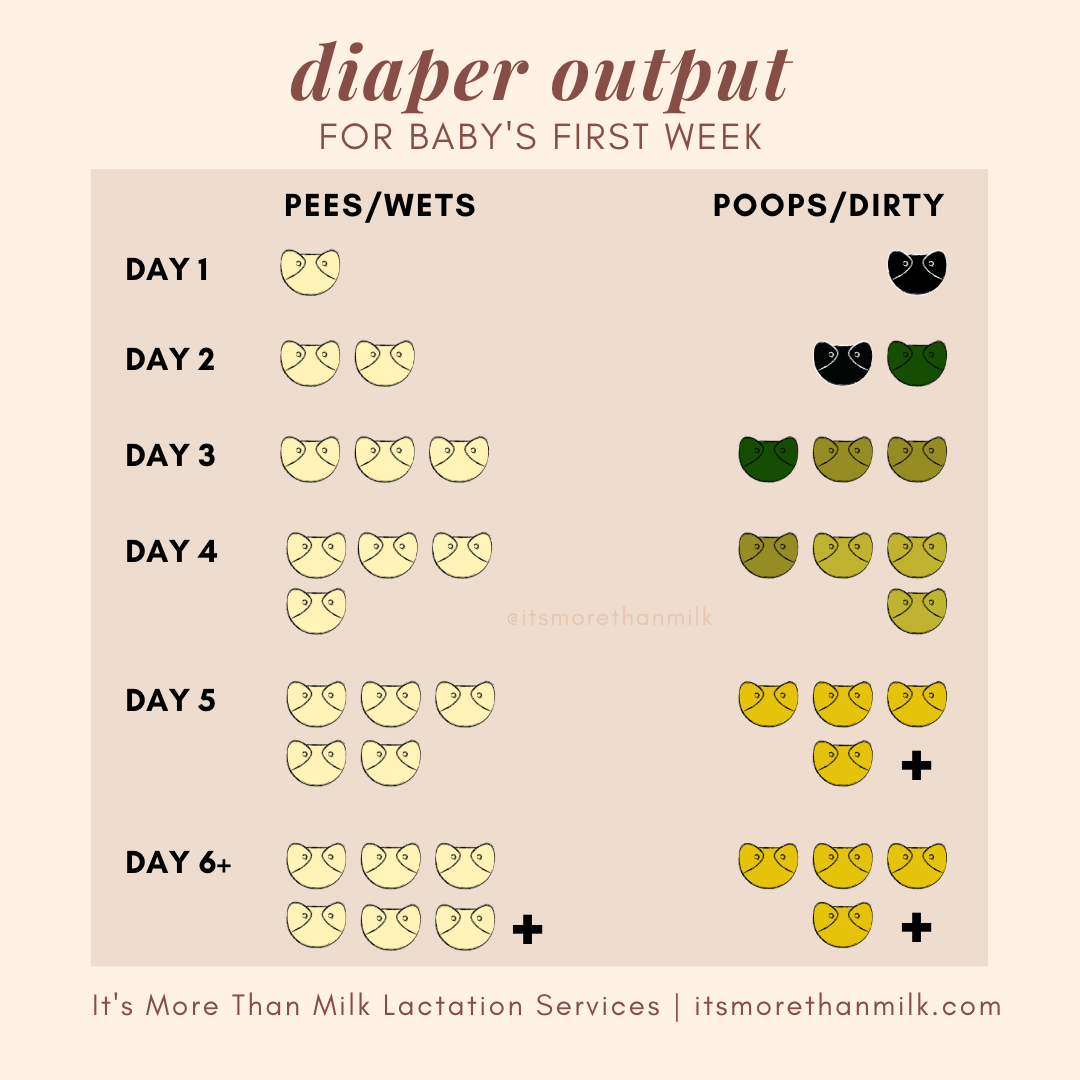
The best and easiest way to ensure your baby is getting enough milk is to monitor their diaper output. You should expect at least one wet and one poop diaper per day of life: two wet and two dirty diapers on day 2, three pees and three poop diapers on day 3, etc. Dirty diapers typically slow down around five days, but you should continue to see multiple poop diapers per day.

Your baby’s poop will go from black/dark green and tarry (meconium) to a mustard colored seedy poop by around day 5. The black, dark green/brown, tarry and sticky first poop is called meconium. One of the functions of colostrum is that it has a laxative effect to help get your baby pass meconium.

Baby’s urine should be a pale yellow color, and be plentiful after day 6, with your baby having at least 6-7 wet diapers in 24 hours.

While it may seem simple enough to remember whether you changed a diaper or not, it can be very helpful to record/write this information down. You don’t necessarily need an app, even a note on your phone can be sufficient.

If you notice that your baby isn’t making enough diapers, they may not be getting enough milk. If this happens, reach out to your pediatrician AND to an IBCLC.

Want to learn more about what to expect after your baby’s birth? Cuddle and Flow Prenatal Lactation Prep happens monthly, and 2024 dates are open for registration. This is a small group in-person class. Slide into my DMs or visit bit.ly/itsmorethanmilk24 for more information and to register. Your partner or support person is welcome to join us.

Read More
breastfeeding, parenting, pumping It's More Than Milk breastfeeding, parenting, pumping It's More Than Milk

Postpartum Intimacy

Navigating the waters of intimacy after having children can be difficult. This can be especially true if you're a lactating person. Sit back and grab a cup or glass of your favorite beverage, let's have an honest chat about sex while lactating. 

Navigating the waters of intimacy after having children can be difficult. This can be especially true if you're a lactating person. There are many emotions going on when it comes to our bodies and our breasts or chest postpartum - it can feel like your body belongs to the baby, not to you. For some people, it can be hard to feel that they’re a sexual being when they’re nurturing a tiny human with their body.


This thinking may be why some people are hesitant to share their body with their partner. The feelings make discussing this topic uncomfortable. Is this a topic for our OB, lactation consultant, or our friends? It can be tough to find someone that won't judge us and will provide us with useful and honest information? Sit back and grab a glass of your favorite beverage, let's have an honest chat about sex while lactating. 

Your sex drive could be non-existent

It’s common for many new parents to have no desire for sex. Crying babies, lack of sleep, adjusting to life with a new baby, and hormonal shifts can make sex fall off your to-do list. Prolactin, the hormone that stimulates the mammary glands to make milk, is also known to suppress estrogen (a reproductive hormone) which can reduce your sex drive. Does your partner mentioning sex make you laugh out of sheer absurdity? You’re not alone. 


Your breasts/chest may be off limits

 Many parents report feeling “touched out” from the frequent feeds or pumping, and may not want their breasts/chests involved in any kind of sexual activity. It’s important to be clear with your preferences when speaking to your partner. A caress can quickly kill desire and put an end to the romance. In addition to feeling touched out, some people have trouble reconciling that their breasts/chest can be sensual and functional. If you prefer your breasts/chest not be touched, you are not alone. It’s not a weird or unusual way to feel while making milk. On the other hand…

It could be all about your milk makers

 Some people want just as much breast/chest play during sex as they desired before children or nursing. Some women have reported that breastfeeding makes them feel more feminine and womanly due to larger breasts. Different strokes for different folks - literally. If this is you, then get it! Be sure to communicate touch, pressure, and other things with your partner to keep the sexy vibe going.


Lubricant is your friend

 Many milk making parents report vaginal dryness and little to no cervical mucus. This is due to low levels of estrogen. Even if you want to have sex with your partner, the dryness can make it uncomfortable. A good personal lubricant will help, as will taking your time, and letting your partner know how it feels. If you think that you have enough lube, add a little more. Communication and lubricant are key!

You can have letdown during orgasm

 This is a big one that often surprises many couples. Oxytocin is one of the hormones responsible for milk ejection reflex or letdown. It’s a smooth muscle contractor that plays an important role in childbirth as well. It is also the hormone that is released during an orgasm. Breastfeeding mamas report milk ejection reflex at orgasm, which can be embarrassing or uncomfortable for anyone involved. If reading this section made you cringe, you can leave your bra on during sex to prevent an accidental spraying.

You might not be ready

Once you’ve gotten clearance from your health care provider and have figured out contraception, remember to move at your own pace. It’s also important to remember that being cleared by your OB or midwife doesn’t mean that you’re ready. You just went through major life and physical changes! You may have hemorrhoids, soreness, or you just may not be there mentally and emotionally.

Remember that intimacy can be so much more than intercourse. Communicate your needs to your partner and be sure that they are communicating their needs with you. Finding alternate ways to connect, such as massage or doing an activity together, may be what you need until you are ready to connect with sex. You may have to get creative or plan ahead for intimacy, but the extra time and work is usually worth it.


Photo by Malvestida on Unsplash

Read More
breastfeeding, pumping, parenting It's More Than Milk breastfeeding, pumping, parenting It's More Than Milk

How to Survive the Holidays as a New Parent

For all new parents, everywhere. Practical advice from a mom and IBCLC

The holidays can be full of joy: making memories with loved ones, first meetings between Baby and extended family members, and the joy in being surrounded by people you don't see very often. Oftentimes those joyful moments can be overshadowed by the stress of travel, planning, parties, and family. Here are a few tips on how to survive the next few months as a new parent.

Pass the Gravy, Not the Baby

This seems obvious, but there can often be well meaning relatives that insist on feeding the baby. If you don't want to let your great aunt feed the baby, remember that you can say no. There are plenty of other ways for family members to bond with baby that don't have to do with feeding. If you are okay with others giving the baby a bottle, show them how to use paced bottle feeding to help transition between breast and bottle. Remember that you do not have to hide out in a separate room to nourish your baby - feed/nurse/pump wherever and however you and baby are most comfortable!

Smile and Nod

Family members may pass judgement in your feeding decisions as "advice," sometimes it is just best to nod and say thanks. They may comment on how frequently baby is eating, what you're eating, or baby's sleep habits. Feel confident in your decision to provide baby human milk, and also in your parenting decisions. If you're feeling especially sassy, you can come up with an answer defending your feeding choice. The holidays can be a really tense time for many, so taking the high road may not be a bad idea. Sometimes it is best to just smile and nod as you let the "advice" go in one ear and out the other.

Keep Baby Close

Adults aren't the only ones who can get stressed in new situations, babies do, too. Not only will keeping baby close help with new situations, but it will also help keep you calm. Wearing your infant is a great way to keep baby happy and close enough to respond to early feeding cues. It can reduce germs and the chances of your LO smelling like your second cousin's perfume or cologne. Remember that if you don't want someone else to hold the baby, it's okay say no. This is a baby, not a baton - no need to pass them around!

Dress for the Occasion

For the nursing and pumping parents, it can be helpful to wear nursing or pumping friendly clothing, especially when you're going to be around new people who may not be used to a baby being breastfed or chestfed in the open. Additionally, easy boob access means less messing with clothes while your hungry baby fusses. A stretchy tank top under your regular top can make a world of difference!

Take Care of You

With travel schedules, guests, and parties to attend, it can be easy for us parents to forget about ourselves. Be sure to eat regularly and stay hydrated - you may notice a drop in milk supply if you skip meals or don’t hydrate. It can also make things seem a lot worse than they are - it’s called “hanger” for a reason! This can also mean using a fussy baby as an excuse to escape to a quieter part of the house for a feed or snuggle. On the other hand, taking care of yourself can mean leaving the baby with people you trust while you enjoy time alone or with your partner. Whatever "taking care of yourself" means to you, give yourself permission to do it.

Photo by Billy Huynh on Unsplash

Make All the Memories

Despite all the stress, the holidays are a special time for many families, particularly those with small children. One of my most favorite things about motherhood is seeing things all over again through my children's eyes. There's something just so magical about a light show, a Thanksgiving day parade, and even Santa Claus. It's okay to indulge in that salted caramel latte or glass of champagne. Remember to take lots of photos for you to enjoy for years to come. Breastfeeding selfie in front of the fireplace, anyone?

Read More